Where You Might Have Seen This Notation
If you have looked through a test report or specification sheet for a silicon-containing material — such as silicone rubber, silicone adhesive, or thermal interface material — you may have seen a table with a "Ret. Time" (retention time) column on the left, a list of compound names running from D3 to D10 in the middle, and concentration values on the right, most often marked "N.D." (Not Detected).
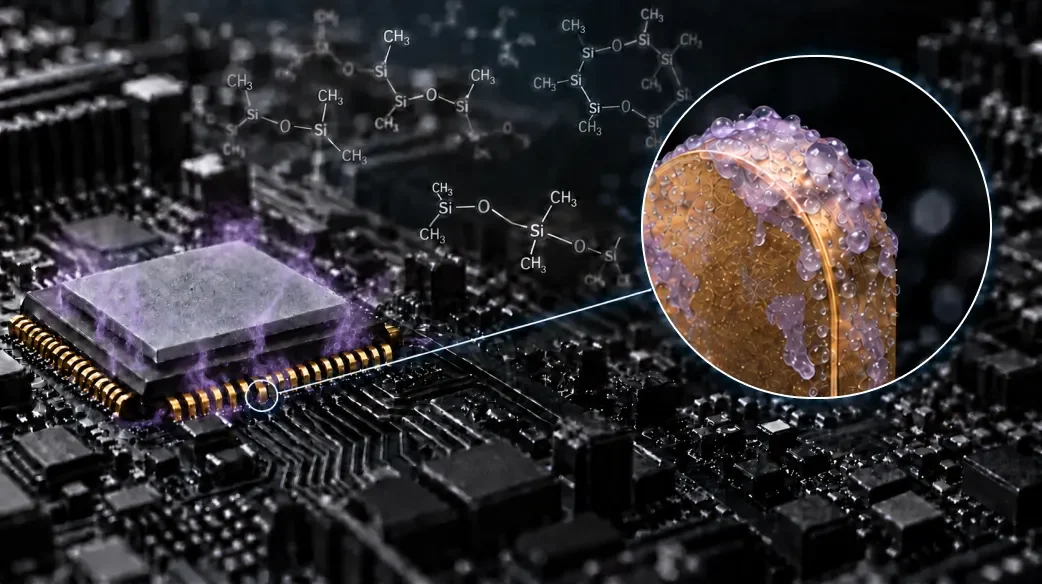
This D3–D10 notation refers to Low Molecular Weight Cyclic Siloxanes — the smallest, most volatile members of the siloxane family. This article explains, in accessible terms, what these compounds are chemically, why they volatilize, and why the electronics industry pays close attention to them.
Siloxane 101: The Building Block of Silicone
Silicone is a polymer built on an alternating silicon–oxygen backbone (Si–O–Si), with each silicon atom typically bonded to two methyl groups (–CH₃). Linking and cross-linking many [–Si(CH₃)₂–O–] units together produces the elastic, heat-resistant solid or gel structures recognized as silicone.
However, not every small unit fully participates in the cross-linking reaction during polymerization and curing. Some instead close into small cyclic (ring-shaped) molecules rather than joining the main network — and these cyclic small molecules are exactly what D3 through D10 are.
D3–D10: A Consistent Naming Pattern
Chemists use the letter "D" to denote one repeating dimethylsiloxane unit [–Si(CH₃)₂–O–], and the number that follows indicates how many of these units are linked head-to-tail to form the ring. The more units in the ring, the larger — and heavier — the molecule:
Molecular formula: C6H18O3Si3 | n = 3
Molecular formula: C8H24O4Si4 | n = 4
Molecular formula: C10H30O5Si5 | n = 5
Molecular formula: C12H36O6Si6 | n = 6
Molecular formula: C14H42O7Si7 | n = 7
Molecular formula: C16H48O8Si8 | n = 8
Molecular formula: C18H54O9Si9 | n = 9
Molecular formula: C20H60O10Si10 | n = 10
| Code | Compound Name | Silicon Atoms in Ring |
|---|---|---|
| D3 | Hexamethylcyclotrisiloxane | 3 |
| D4 | Octamethylcyclotetrasiloxane | 4 |
| D5 | Decamethylcyclopentasiloxane | 5 |
| D6 | Dodecamethylcyclohexasiloxane | 6 |
| D7 | Tetradecamethylcycloheptasiloxane | 7 |
| D8 | Hexadecamethylcyclooctasiloxane | 8 |
| D9 | Octadecamethylcyclononasiloxane | 9 |
| D10 | Eicosamethylcyclodecasiloxane | 10 |
The pattern is simple: the number after "D" equals the number of silicon atoms (and oxygen atoms, and repeating units) in the ring. A smaller number means a lighter molecule; a larger number means a heavier one. [1]
Why "Low Molecular Weight" Means "Easily Volatilized"
It's worth clarifying a concept often glossed over in introductory chemistry: a liquid or solid does not need to reach its boiling point to evaporate. As long as it has any measurable vapor pressure at ambient temperature, molecules will continue to slowly escape into the air.
Concrete data illustrates this well: D4 (octamethylcyclotetrasiloxane) has a boiling point of roughly 175–176°C, yet at 25°C it still exhibits a vapor pressure of approximately 124.5 Pa. D5, a heavier molecule, boils at roughly 210°C and has a much lower vapor pressure of about 20.4 Pa at the same temperature — the larger the molecule, the lower the vapor pressure, and the less readily it volatilizes. [2][3] This explains why lighter members like D3 and D4 continue to slowly off-gas at room temperature — or the elevated operating temperatures inside electronic devices — even without ever approaching their boiling points.
It's also worth noting that these volatile small molecules are not part of the silicone's main cross-linked structure; rather, they are residual by-products left behind after curing that never fully incorporated into the network. Academic research in the electronic packaging field has used gas chromatography–mass spectrometry (GC/MS) to identify low molecular weight cyclic siloxanes residing in silicone dielectric gels, noting that while these compounds generally have relatively high boiling points, they nonetheless continue to escape gradually over time. [4]
Why the Electronics Industry Cares: The Mechanism Behind Contact Failure
This is the most frequently cited reason D3–D10 test reports are requested. When a silicone-containing material is located near a relay, switch, connector, or any component that opens and closes mechanically (generating an electrical arc in the process), the following chain of events can occur:
- Volatilization:low molecular weight siloxane escapes from the material's surface as a gas and diffuses within an enclosed space.
- Adsorption:the gaseous molecules contact and adsorb onto the surface of nearby metal contacts.
- Decomposition into silicon dioxide:an electrical arc forms at the instant a contact opens or closes, with localized temperatures reaching thousands of degrees. Academic studies observed — under both static high-voltage heating and dynamic switching conditions — that siloxane vapor adsorbed on contact surfaces decomposes and oxidizes under this heat, forming deposits of silicon dioxide (SiO₂), typically more pronounced on the cathode. [5]
- Insulating buildup and failure:silicon dioxide is itself an electrical insulator. As it accumulates on the contact surface over repeated cycles, contact resistance rises, eventually causing intermittent conduction or complete failure — what the industry calls "contact failure."
This mechanism is also documented in relay manufacturers' technical literature: even a coating marketed as "low-siloxane" still contains siloxane, and will only delay — not prevent — its migration into the relay and the formation of an insulating oxide film on the contact. [6] Suppliers of dedicated siloxane gas detection equipment likewise list this phenomenon as a recognized reliability risk in automotive electronics and precision electromechanical products. [7]
A Related Concern: Optical Surface Contamination
Volatile organic compounds released from silicone-containing materials — including low molecular weight siloxanes — can also deposit over time onto nearby optical surfaces, a form of "outgassing contamination." Patent literature describes an extraction and gas chromatography quantification procedure specifically for D3–D20 low molecular weight siloxane residues in optical components, indicating that the optics industry does treat this as a quality-control parameter. [8] Separately, academic research on high-power laser optical systems has observed that outgassing contamination containing organics such as siloxanes, once deposited on optical surfaces, can increase the risk of laser-induced damage at specific wavelengths. [9] It should be noted that this body of research largely concerns systems with extreme sensitivity to contamination; the actual impact on general-purpose electronic optical components will depend on the specific application and material quantities involved, and should not be generalized without qualification.
The Regulatory Angle: Why D4, D5, and D6 Are Listed as Substances of Very High Concern (SVHC)
Beyond electronics reliability, D4, D5, and D6 have separately drawn attention under the EU's REACH chemical regulation. In June 2018, the European Chemicals Agency (ECHA) added octamethylcyclotetrasiloxane (D4), decamethylcyclopentasiloxane (D5), and dodecamethylcyclohexasiloxane (D6) to the SVHC (Substances of Very High Concern) Candidate List, based on their persistent, bioaccumulative, and toxic (PBT) or very persistent, very bioaccumulative (vPvB) properties. [10][11] This regulatory listing is motivated by environmental and ecological concerns — a different consideration entirely from the electrical contact failure mechanism discussed above. The former concerns long-term persistence and accumulation of the substance in the environment; the latter is a physical failure mode caused by volatilized material on electrical components. The two mechanisms should not be conflated, though both contribute to industry's ongoing motivation to monitor and disclose D3–D10 content.
How the Industry Tests: What Gas Chromatography Does, and Why Testing Extends Through D10
The "Ret. Time" (retention time) column commonly seen in catalogs or test reports comes from the principle behind Gas Chromatography (GC): a vaporized sample passes through a chromatographic column, and different compounds — due to differences in molecular size and boiling point — take different amounts of time to pass through. Lighter molecules pass through faster, giving them shorter retention times; this is why D3 appears first in the table and D10 last. By recording detector signal intensity at each retention time, the concentration of each compound in the sample can be calculated. This is one of the standard methods used in academic research on electronic packaging to identify residual low molecular weight siloxane content. [4][12]
Because D3–D10 carry this dual significance — electrical reliability risk and regulatory disclosure relevance — material suppliers commonly run GC testing on finished products to quantify each compound individually, compiling the results (sometimes extended through D20) into tables as objective evidence of material quality. Downstream customers — particularly those using materials near precision electrical contacts or optical components — reference this data during material selection. This is the main reason such test reports are widely requested and included in product technical documentation.
Frequently Asked Questions
Q1: Are siloxane and silicone the same thing?
Not exactly. "Silicone" typically refers to the cross-linked, cured polymer material — the finished silicone rubber or gel. "Siloxane" is the broader chemical term for any compound containing a Si–O–Si backbone. The cyclic, low molecular weight siloxanes discussed here (D3–D10) are residual small-molecule by-products left over from the curing process that never joined the main cross-linked network — a member of the broader siloxane family, but not the same as the silicone material itself.
Q2: Does every silicon-containing material carry a contact-failure risk?
The risk stems specifically from the residual, non-cross-linked low molecular weight fraction — not from the fully cross-linked silicone network itself. The amount of residual content varies significantly by formulation and curing process, which is exactly why batch-by-batch GC testing is used. Materials formulated without silicon (non-silicone resin systems) inherently lack this Si–O low molecular weight fraction to begin with, and therefore do not present this particular failure pathway — a technical consideration behind why some applications specify silicone-free materials.
References
- [1] Wikipedia contributors, “Hexamethylcyclotrisiloxane,” Wikipedia
- [2] Wikipedia contributors, “Octamethylcyclotetrasiloxane,” Wikipedia
- [3] Wikipedia contributors, “Decamethylcyclopentasiloxane,” Wikipedia
- [4] N. Urasaki, C. P. Wong et al., “Separation of Low Molecular Weight Siloxanes for Electronic Packaging Applications,” Georgia Institute of Technology repository
- [5] “Adsorption of Silicone Vapor on the Contact Surface and Its Effect on Contact Failure of Micro Relays,” ResearchGate
- [6] OMRON Device & Module Solutions – Americas, “If the side of a relay is coated with silicon that contains siloxane… will contact failure occur?” FAQ
- [7] HORIBA, “Total Siloxane Analyzer for Electrical Parts’ Contact Failure”
- [8] “Optical Member with Reduced Low-Molecular-Weight Siloxane Content, and Method for Producing Same,” US Patent (USPTO)
- [9] “Impact of Storage Induced Outgassing Organic Contamination on Laser Induced Damage of Silica Optics at 351 nm,” PubMed
- [10] TEGEWA, “Position ‘Cyclic Siloxanes on Candidate List'”
- [11] CIRS Group, “ECHA Proposes to Add Seven Substances to the Authorisation List”
- [12] “A Practical Gas Chromatography Flame Ionization Detection Method for the Determination of Octamethylcyclotetrasiloxane, Decamethylcyclopentasiloxane, and Dodecamethylcyclohexasiloxane in Silicone Emulsions,” ScienceDirect
- Shiu Li Technology Co., Ltd. (LiPOLY), 2026 E-Catalogue (Traditional Chinese edition, 2026/04/13), Low Molecular Siloxane test table (D3–D10 / GC data) — internal catalog, referenced for D3–D10 naming cross-check and test-report format only.