

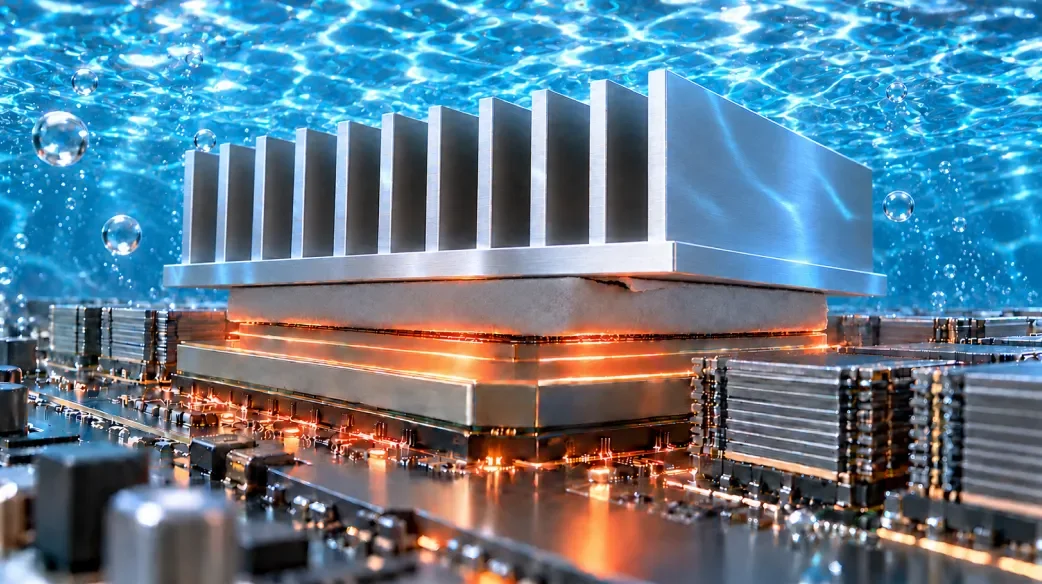
As the power consumption of individual AI GPU modules surpasses 700 W and moves toward the 1,000 W level, the physical limitations of air cooling are becoming increasingly inadequate for rack-level heat-flux requirements. Immersion cooling has therefore emerged as an important option for data center thermal architectures. According to Fortune Business Insights, the global data center liquid immersion cooling market is projected to grow from USD 348.3 million in 2026 to USD 1.694 billion by 2033, representing a compound annual growth rate of approximately 21.9% [1].
However, when servers and chip modules transition directly from air cooling to an environment immersed in dielectric coolant, many thermal interface materials (TIMs) inherited from air-cooled designs have not been validated for liquid compatibility. Conventional silicone thermal pads are among the material types most frequently questioned by the industry. In some cases, thermal pads have exhibited volumetric swelling and material softening after prolonged immersion. This article examines the causes and consequences of this phenomenon from the perspective of polymer materials science and discusses potential material-design solutions.
Why Immersion Cooling Presents a New Challenge for Thermal Materials
In air-cooled or conventional liquid-cooled systems using cold plates, a TIM only needs to withstand exposure to air or contact within a closed water loop. In immersion cooling, however, the TIM remains fully immersed in coolant for extended periods, making material compatibility a factor that must be independently validated. A study presented at the 2016 IEEE Intersociety Conference on Thermal and Thermomechanical Phenomena in Electronic Systems (ITherm) noted that fully immersing IT equipment in mineral oil can provide significant energy and space benefits. However, changes in the physical and chemical properties of materials including PVC wiring, PCBs, and connectors during long-term oil immersion remain a major uncertainty for manufacturers adopting immersion cooling [2]. This is why coolant suppliers and server integrators have begun establishing formal compatibility-validation procedures for TIMs, seals, cables, and other nonmetallic materials.
Why Does Silicone Swell in Hydrocarbon-Based Coolants? The Role of Solubility Parameters
Single-phase immersion cooling fluids can generally be divided into two categories: mineral-oil or synthetic-oil coolants based primarily on hydrocarbons, such as synthetic alkanes and isoparaffins, and fluorocarbon coolants based on fluorinated compounds. Differences in their chemical structures directly affect their compatibility with silicone.
The polymer base of silicone thermal materials is polydimethylsiloxane (PDMS), whose molecular chains consist almost entirely of nonpolar Si–O and C–H bonds. According to the “like dissolves like” principle of polymer science, nonpolar hydrocarbon coolant molecules have solubility parameters (δ) relatively close to that of PDMS. This results in a relatively low Flory–Huggins interaction parameter and increases the driving force for solvent penetration into the polymer network. A classic study published in the American Chemical Society journal Analytical Chemistry investigated the compatibility of PDMS microfluidic devices with organic solvents. Its experimental results confirmed that the degree of PDMS swelling is closely related to the solvent’s solubility parameter and that swelling had the greatest impact among the three compatibility indicators examined [3]. By contrast, the large number of fluorine atoms surrounding the carbon backbone of fluorinated coolants gives them surface-tension and polarity characteristics that differ substantially from those of hydrocarbon coolants. They also tend to cause less swelling in conventional elastomeric materials [4]. Therefore, there is no single answer to whether silicone will swell in a coolant. The outcome depends on both the coolant chemistry and the molecular design of the silicone material.
What Are the Practical Consequences of Insufficient Material Compatibility?
- Increased Bond Line Thickness (BLT) and Higher Thermal Resistance:Material swelling increases the volume of the thermal layer and consequently raises interfacial thermal resistance. As a result, the chip junction temperature may rise rather than fall.
- Reduced Structural Stability:Coolant supplier Submer notes in its technical article on material compatibility that sealing materials such as EPDM, natural rubber, nitrile rubber (NBR), and silicone all show a pronounced tendency to swell in single-phase immersion cooling fluids. This may compromise their original sealing or conformability functions [5].
- Increased Burden on the Coolant System:In its technical FAQ, coolant supplier Engineered Fluids explains that silicone thermal greases and thermal pads are generally compatible with its dielectric coolants when fully cured. They may absorb a small amount of fluid and swell slightly, but this generally does not affect thermal performance. This also implies that compatibility and risk may be less predictable when a material is not fully cured. Each material should therefore be verified against the supplier’s official compatibility guidance [6].
- Uncertainty in Long-Term Reliability:As noted in the aforementioned IEEE ITherm study, changes in long-term material properties under immersion remain factors that must be individually validated through experimental data before immersion cooling can be deployed broadly in data centers [2].
The Solution: Improve Fluid Resistance Through Complete Curing and Compatibility Validation
In other words, determining whether a silicone thermal material is suitable for immersion cooling does not depend simply on whether it contains silicone. The critical factors are whether the material has been fully cured, whether compatibility testing has been conducted against the chemical characteristics of the target coolant, and whether the supplier can provide supporting reliability data.
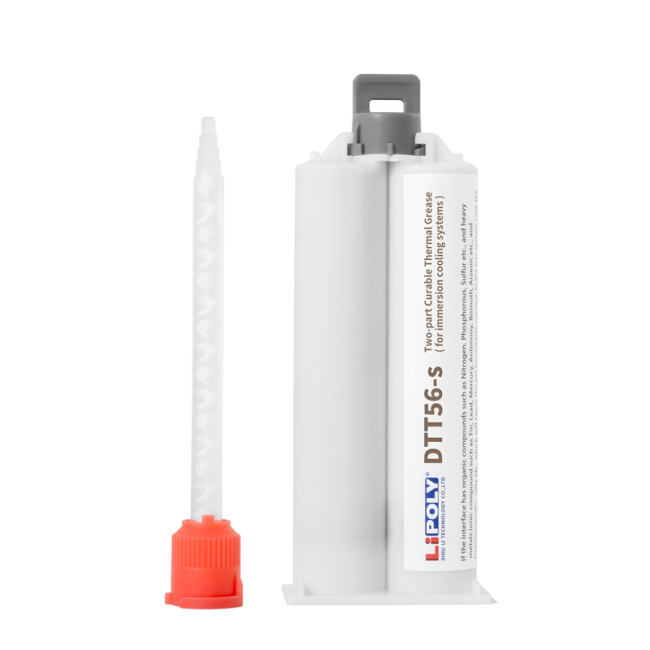
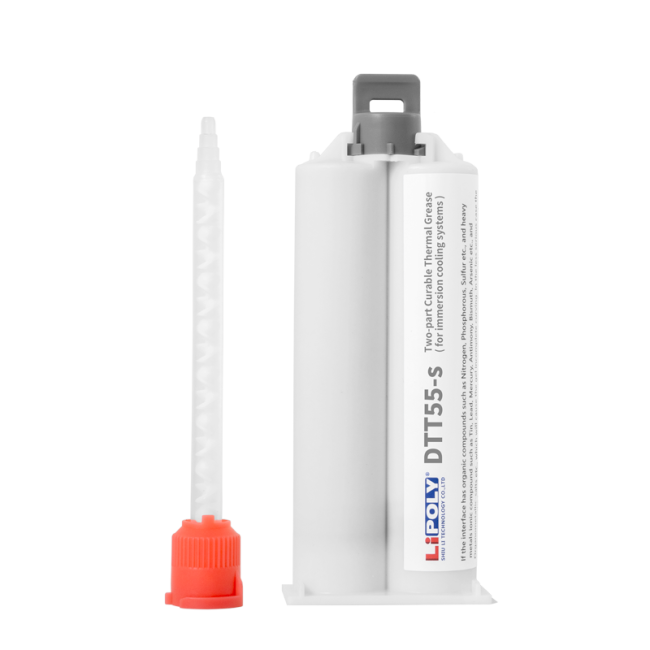
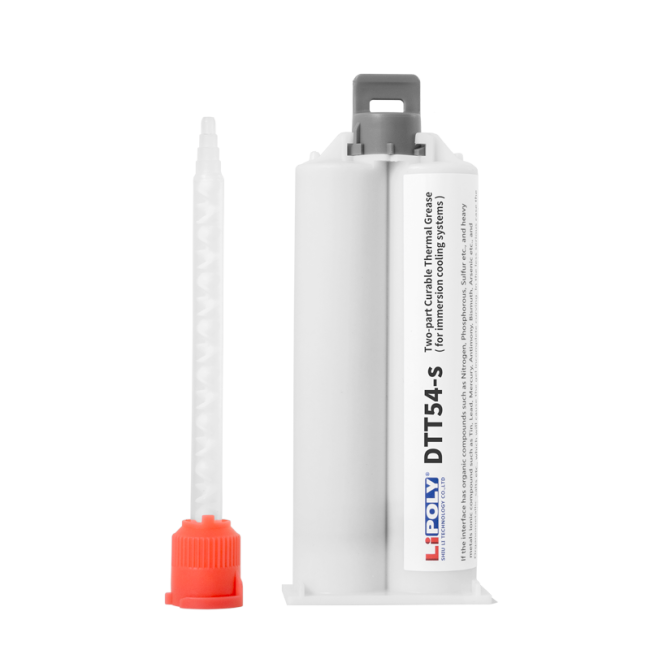
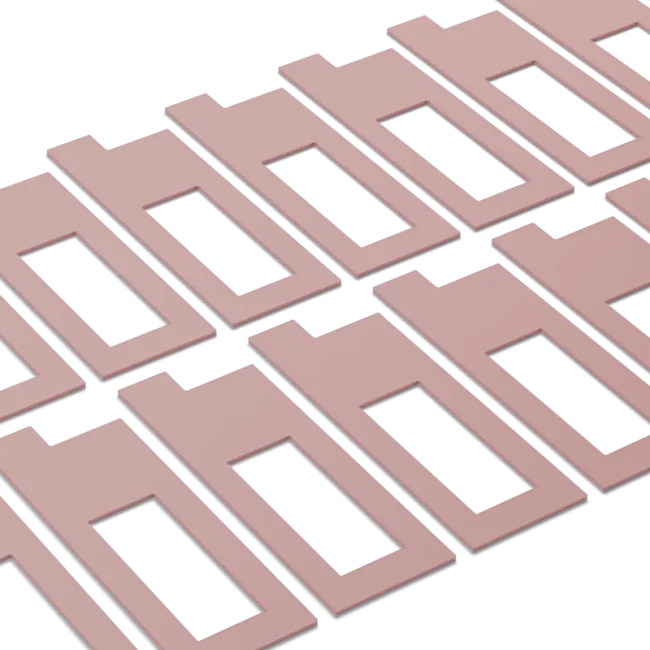
LiPOLY Thermal Materials for Immersion Cooling: DTT54-s / DTT55-s / DTT56-s / DTT61-s
In response to these material-design requirements, LiPOLY has developed the DTT54-s / DTT55-s / DTT56-s series of two-part thermally conductive die-attach adhesives and the DTT61-s immersion-cooling thermal pad for immersion cooling and high-power AI chip applications. All four products are silicone-based thermal materials. DTT54-s, DTT55-s, and DTT56-s are two-component curable TIM-1 materials. Parts A and B are mixed and dispensed, then heat-cured to form a structurally stable thermal-material network. DTT61-s is a preformed thermal pad, also based on silicone, and is designed for prolonged immersion in cooling fluids. This product series does not address swelling by avoiding silicone. Instead, it optimizes the curing process and material structure so that the silicone itself can provide the fluid resistance required for immersion cooling. This reflects the conclusion above: the core issue is molecular design and curing completeness, not the silicone base material itself.
Product Specification Comparison
| Property | DTT54-s | DTT55-s | DTT56-s | DTT61-s |
|---|---|---|---|---|
| Material form | Two-part curable thermally conductive die-attach adhesive | Two-part curable thermally conductive die-attach adhesive | Two-part curable thermally conductive die-attach adhesive | Preformed immersion-cooling thermal pad |
| Resin base | Silicone-based | Silicone-based | Silicone-based | Silicone-based |
| Thermal conductivity (W/m·K, ASTM D5470) | 4.0 | 5.0 | 6.0 | 6.0 |
| Hardness (Shore A, ASTM D2240) | 40 | 25 | 20 | — |
| Density (g/cm³, ASTM D792) | 2.7 | 2.7 | 3.3 | 3.3 |
| Bond line thickness, BLT (μm) | 30 | 30 | 10 | Customizable upon request |
| Dielectric breakdown strength (kV/mm, ASTM D149) | 14 | 14 | 14 | 8 |
| Volume resistivity (Ω·m, ASTM D257) | >1012 | >1012 | >1012 | >1010 |
| Operating temperature range | -60~200°C | -60~200°C | -60~200°C | -60~200°C |
| Shelf life | 24 months (unopened and stored below 30°C) | 24 months | 24 months | — |
| Primary Applications | AI GPU modules, AI immersion-cooled servers, OAM/HGX accelerator cards, and high-power EV electronic modules | Same as left | Same as left | Immersion-cooled interfaces between GPUs/AI accelerators and cold plates |
FAQ
Q1: Are All Silicone Thermal Materials Unsuitable for Immersion Cooling?
No. Whether a material is suitable for immersion cooling depends on the curing completeness and material-structure design of the specially structured silicone—not simply on whether the material is silicone. Fully cured, two-component silicone thermal materials that form a structurally stable thermal network—such as the complete LiPOLY DTT54-s / DTT55-s / DTT56-s / DTT61-s series, all of which are silicone-based—are designed with prolonged coolant immersion conditions in mind.
Q2: How Should I Choose Among DTT54-s, DTT55-s, and DTT56-s?
The principal differences are thermal conductivity—4.0, 5.0, and 6.0 W/m·K—hardness, and recommended bond line thickness. Selection can be based on actual chip power, gap dimensions, and process requirements. DTT56-s is generally considered for applications requiring higher thermal conductivity and a thinner gap.
Q3: How Does DTT61-s Differ From the DTT54-s Series?
DTT54-s, DTT55-s, and DTT56-s are two-component liquid dispensing materials that must be mixed and cured. They are suitable for precision dispensing and automated production lines. DTT61-s is a preformed thermal pad that can be cut and applied directly, making it suitable for immersion-cooled module interfaces requiring rapid assembly or removable maintenance.
Q4: Are Relevant Reliability Test Data Available for These Materials?
LiPOLY maintains separate internal reports covering immersion-cooling compatibility and long-term reliability. Detailed data are available upon customer request. Please contact LiPOLY through its official channels to reach the appropriate sales representative.
Q5: What Else Should Be Considered When Selecting Materials for Immersion Cooling?
In addition to the thermal material itself, it is advisable to confirm the coolant chemistry—hydrocarbon or fluorocarbon—the maximum allowable junction temperature of the target chip, and the compatibility of cables, seals, and other nonmetallic components with the same coolant. This allows a complete system-level validation to be established.
References
- Fortune Business Insights. Data Center Liquid Immersion Cooling Market, 2026–2033.
- Shah, J. M., Eiland, R., Siddarth, A., & Agonafer, D. (2016). Effects of Mineral Oil Immersion Cooling on IT Equipment Reliability and Reliability Enhancements to Data Center Operations. In 2016 15th IEEE Intersociety Conference on Thermal and Thermomechanical Phenomena in Electronic Systems (ITherm) (pp. 316–325). IEEE.
- Lee, J. N., Park, C., & Whitesides, G. M. (2003). Solvent Compatibility of Poly(dimethylsiloxane)-Based Microfluidic Devices. Analytical Chemistry, 75(23), 6544–6554. American Chemical Society.
- CAPLINQ. Chemical Interaction Between Immersion Cooling Fluids and Thermal Interface Materials.
- Submer. Navigating Material Compatibility in Immersion Cooling.
- Engineered Fluids. Material Compatibility Guide — Thermal Interface Materials for Dielectric Coolants (FAQ).
- Czaplewski, S. K., Kuczynski, J., Wertz, J. T., & Zhang, J. (2018). Silicone-Based Thermal Interface Materials. U.S. Patent No. 9,911,681 B2. International Business Machines Corporation.
- Shiu Li Technology Co., Ltd. (LiPOLY), 2026 E-Catalogue (Traditional Chinese edition, 2026/04/13), Low Molecular Siloxane test table (D3–D10 / GC data) — internal catalog, referenced for D3–D10 naming cross-check and test-report format only.
Related Products