

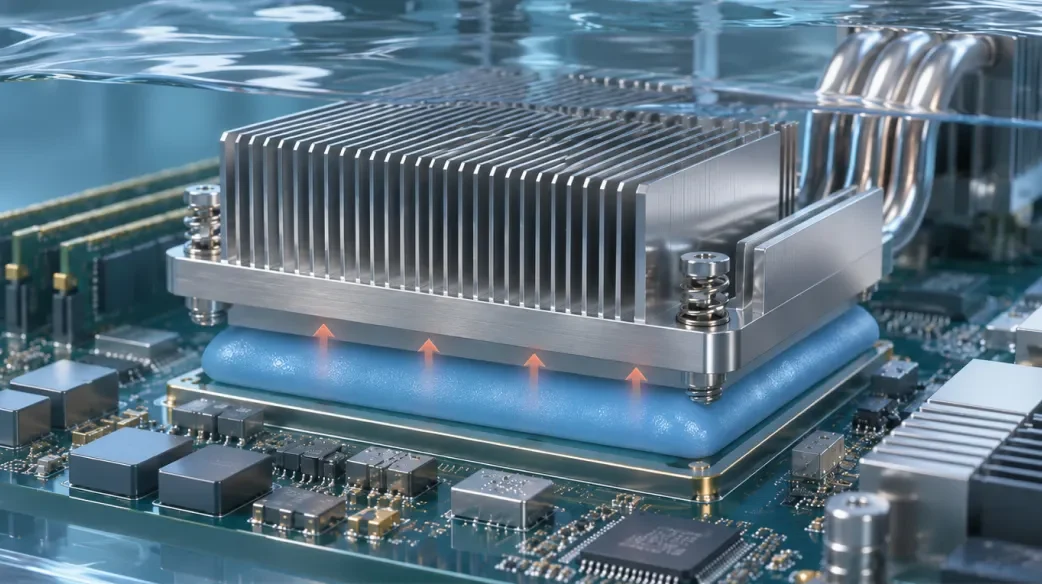
As the power consumption of individual AI servers continues to rise, data center cooling architectures are gradually shifting from air cooling to liquid cooling. Immersion cooling submerges an entire server directly in a non-conductive dielectric coolant, allowing the liquid to remove heat directly from the components. It is an important option for high-density computing environments.
In this architecture, every material inside the server remains in prolonged contact with the coolant, including the thermal interface material (TIM) between the chip and the heat sink. The fact that a material can be placed in a coolant does not mean it can maintain its original performance over long-term immersion. This article explains the principles of immersion cooling, the main types of coolants, compatibility issues between coolants and materials, and how long-term immersion testing can be used to verify TIM compatibility.
Immersion Cooling Principles: Single-Phase and Two-Phase Systems
Immersion cooling is divided into two system architectures according to whether the coolant undergoes a phase change during operation.
- Single-phase immersion cooling:The server is typically immersed in a hydrocarbon-based dielectric coolant similar to mineral oil. Because the coolant has a relatively high boiling point, it remains liquid throughout operation. A pump sends the coolant to a heat exchanger in the coolant distribution unit (CDU), where it is cooled before returning to the tank for recirculation[1].
- Two-Phase Immersion Cooling:The coolant boils and vaporizes upon contacting heat-generating components, removing heat through the latent heat of vaporization. The vapor is then condensed back into liquid by a condenser. Because the coolant vaporizes, the system requires more extensive coolant replenishment and sealing management[2].
Both architectures share one characteristic: the components and materials inside the server are directly and continuously immersed in the coolant. This is the primary difference between immersion cooling, air cooling, and cold-plate liquid cooling—and why material compatibility is a critical issue.
Types of Immersion Cooling Fluids
Immersion cooling fluids must provide both electrical insulation and effective heat transfer. Coolants traditionally used in the industry mainly include fluorocarbons, hydrocarbons or synthetic oils, and silicone oils[2]. Recent studies have also included ester-based coolants in comparisons[7]. Each coolant type has a different chemical structure and therefore exhibits different compatibility with polymer materials.
| Coolant Type | Examples | Common Architecture | Compatibility Considerations |
|---|---|---|---|
| Hydrocarbon-Based | Mineral oil, polyalphaolefin (PAO), and GTL synthetic oil | Single-Phase | The most commonly used type in single-phase systems. As nonpolar liquids, hydrocarbon coolants may cause swelling in similarly nonpolar polymer materials. |
| Ester-Based | Natural and synthetic esters | Single-Phase | Their chemical structure differs from hydrocarbon coolants, so compatibility must be verified for each material.[7] |
| Silicone Oil | Siloxane-based coolant | Single-Phase | May cause silicone materials to swell and change shape or dimensions. |
| Fluorinated Fluid | Perfluorocarbons and hydrofluoroethers (HFE) | Two-phase and some single-phase systems | Generally causes less swelling in polymers such as PDMS, but these fluids are PFAS substances, and their supply and regulatory environment are changing. |
Two Additional Points:
- Compatibility of hydrocarbon-based coolants has continued to improve, but individual verification is still required. Schneider Electric notes that modern synthetic oils provide better material compatibility than earlier mineral oils and white oils, substantially reducing many compatibility issues. [4]However, “substantially reduced” does not mean “eliminated.” The performance of a specific material in a specific coolant must still be confirmed through testing.
- The supply environment for fluorinated fluids is changing. 3M completed its exit from PFAS manufacturing by the end of 2025[5], affecting its Novec and Fluorinert electronic fluorinated fluid product lines[6]. When selecting a coolant, supply stability and regulatory risk must now be evaluated alongside thermal performance and material compatibility.
Coolant–Material Compatibility: Three Main Risks
When a TIM remains immersed in coolant for an extended period, it may face three types of risks that do not occur in air-cooled environments.
- Swelling and dimensional changes::According to the “like dissolves like” principle, liquids with similar chemical properties can more readily penetrate polymer materials. A classic study published in the American Chemical Society journal Analytical Chemistry found that polydimethylsiloxane (PDMS) swelled significantly in alkane solvents such as pentane, while showing the least swelling in perfluorinated solvents. Among the three compatibility considerations examined, swelling had the greatest impact.[8] An IBM U.S. patent also explains that mineral oil can dissolve into certain PDMS materials and cause the TIM to expand[9].
- Thermal performance degradation:Material swelling increases the bond line thickness (BLT), which raises thermal resistance and reduces heat transfer efficiency between the two components.[9]
- Component leaching and coolant contamination::Mobile components in the material may be extracted by the coolant, changing material performance and potentially affecting the quality of the coolant throughout the tank. A study presented at the 2025 MRS Fall Meeting conducted long-term immersion testing using four coolant types—silicone oil, hydrocarbon oil, vegetable ester oil, and perfluorocarbon—with four commercially available TIMs. The study examined changes in both the TIMs and the coolants and observed degradation in some TIMs, including swelling and dissolution of phase change materials[7].
An experimental study presented at IEEE ITherm 2022 identified material compatibility between PCB components and coolants as a major consideration before immersion cooling can be deployed at scale in data centers[10]. Immersion cooling provider Submer also lists TIMs among the material categories whose compatibility must be confirmed before servers are deployed in immersion cooling systems[11].
Most of these risks do not emerge after only a few hours of immersion; instead, they accumulate gradually under prolonged, high-temperature conditions.
Further Reading:Why Do Conventional Silicone Thermal Pads Swell in Immersion Cooling Fluids? A Complete Analysis of Material Compatibility
How to Verify Compatibility: Immersion Conditions and Evaluation Criteria
Determining whether a TIM is suitable for a specific coolant requires quantifiable and repeatable long-term immersion testing. The test design generally includes three elements: immersion conditions, evaluation items, and acceptance criteria.
(1) Immersion Conditions
The simplified material compatibility test published by Engineered Fluids recommends heating immersed samples to 80°C or 20°C above the expected operating temperature, whichever is higher, and maintaining that condition for at least 21 days[12]. Immersion at temperatures above normal operating conditions accelerates material aging, allowing the effects of long-term exposure to be observed within a practical test period.
(2) Evaluation Items
Comparisons before and after immersion should cover both the material itself and the coolant.
| Evaluation Items | Key Observations | Associated Risks |
|---|---|---|
| Material Appearance | Discoloration, swelling, cracking, and deformation | Structural damage and dimensional changes |
| Coolant Appearance | Discoloration or other abnormalities | Component leaching and coolant contamination |
| Thermal conductivity | Rate of change before and after immersion | Thermal performance degradation |
| Hardness | Rate of change before and after immersion | Softening, hardening, or structural degradation |
(3) Acceptance Criteria and Physical Significance
Under one-dimensional steady-state heat conduction, the thermal resistance of the thermal layer can be simplified as:
R ≈ BLT ÷ k
Here, R is thermal resistance, BLT is bond line thickness, and k is thermal conductivity.
If the BLT remains unchanged and thermal conductivity decreases by 10%, thermal resistance increases by approximately 11%(1 ÷ 0.9 ≈ 1.11). If material swelling increases the BLT by 10%, thermal resistance likewise increases by approximately 10%. In other words, changes of several percent to more than 10% in thermal conductivity or material dimensions can directly affect chip temperature.
Hardness determines how the material compresses and conforms under assembly pressure. A significant decrease in hardness may indicate that the material has absorbed coolant and softened. A significant increase in hardness may indicate the loss of internal material components. Both changes can alter the actual BLT and contact conditions in the assembled system.
Therefore, keeping changes in thermal conductivity and hardness within a defined range, such as ±10%, provides a practical criterion for determining whether a material can retain its original design performance after long-term immersion.
Note: R ≈ BLT ÷ k is a simplified estimate of the bulk thermal resistance of the thermal layer and does not include contact resistance between the material and the mating surfaces.
Test Case: Immersion in Shell S3 X at 80°C for 504 Hours
The following test, recently completed by the in-house laboratory at LiPOLY, demonstrates the practical application of the verification method described above.
Test Medium: Shell Immersion Cooling Fluid S3 X
Shell Immersion Cooling Fluid S3 X is a synthetic single-phase immersion cooling fluid manufactured by Shell using gas-to-liquids (GTL) technology[14]. Its official technical data describes it as a stabilized hydrocarbon-based coolant for applications including data centers, high-performance computing, edge computing, and blockchain[13]. Its typical properties are shown below [13]:
| Property | Test Method | Typical Value |
|---|---|---|
| Density at 15°C | ASTM D4052 | 808 kg/m³ |
| Flash Point | ASTM D92 | 198°C |
| Pour Point | ASTM D97 | −42°C |
| Kinematic Viscosity at 40°C | ASTM D445 | 9.9 mm²/s |
| Neutralization Value | IEC 62021-1 | < 0.01 mg KOH/g |
Source: Shell Immersion Cooling Fluid S3 X Technical Data Sheet, v1.7. The listed values are typical values and are not guaranteed specifications.
A technical document jointly published by Shell and Cisco states that S3 X has undergone extensive compatibility testing with metals, polymers, and elastomers used in server hardware[15]. However, the compatibility of individual TIMs must still be verified using the actual coolant. S3 X is a hydrocarbon-based coolant, a category for which the swelling risks discussed in Section 3 require particular attention, making it a representative test medium.
Test Condition
| Property | Conditions |
|---|---|
| Immersion Medium | Shell Immersion Cooling Fluid S3 X |
| Immersion Temperature | 80°C |
| Immersion Duration | 21 days (504 hours), continuously |
| Immersion Method | Test specimens fully immersed in coolant and placed in a constant-temperature oven |
| Evaluation Items | Material appearance, coolant appearance, thermal conductivity, and hardness |
| Acceptance Criteria | No visible material degradation, no coolant discoloration, and changes in thermal conductivity and hardness within ±10% |
The immersion temperature and duration are the same as those specified in the Engineered Fluids procedure described in Section 4[12].
Test Result
| Tested Part Number | Material Appearance | Coolant Appearance | Thermal conductivity | Hardness |
|---|---|---|---|---|
| AS02 | Pass | Pass | Pass | Pass |
| AS03 | Pass | Pass | Pass | Pass |
| AS05 | Pass | Pass | Pass | Pass |
| AS06 | Pass | Pass | Pass | Pass |
| AS07 | Pass | Pass | Pass | Pass |
Testing Facility: Shiu Li Technology in-house laboratory. The tested materials included pad and paste/gel types.
Under these test conditions, none of the five materials showed visible degradation after immersion, the coolant showed no discoloration, and changes in thermal conductivity and hardness remained within ±10%. These results indicate that the materials demonstrate good compatibility and performance stability in Shell S3 X and may serve as a basis for further evaluation in immersion cooling system applications. For actual applications, verification should still be performed using the coolant, temperature, and assembly conditions of the target system.
LiPOLY Thermal Interface Materials for Immersion Cooling
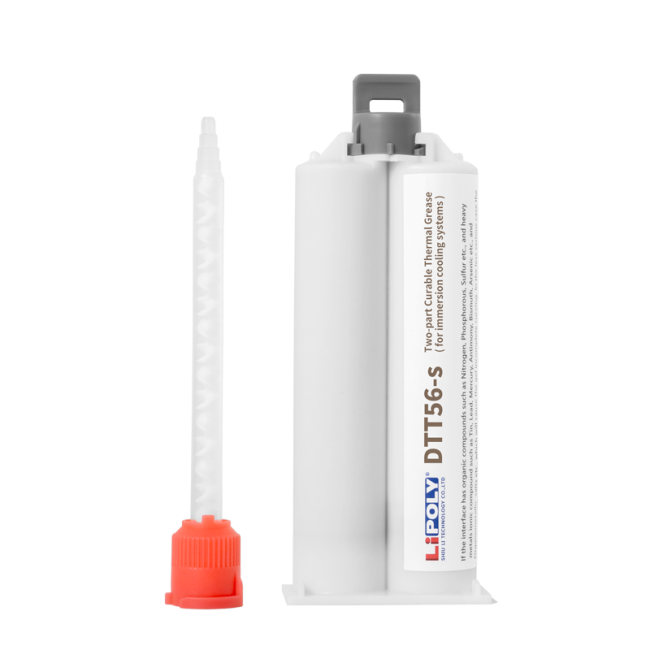
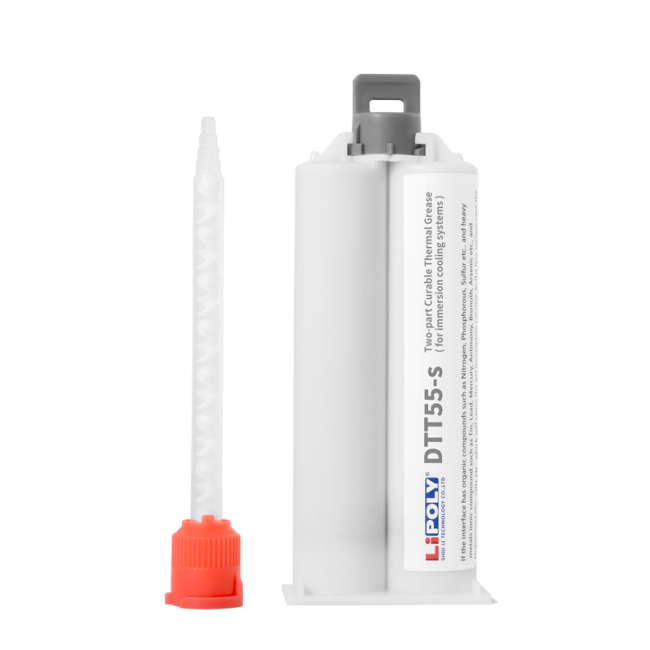
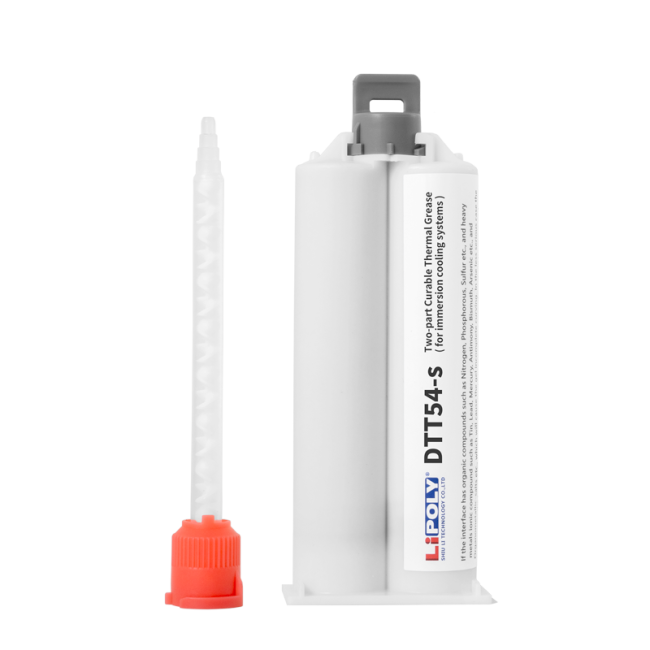
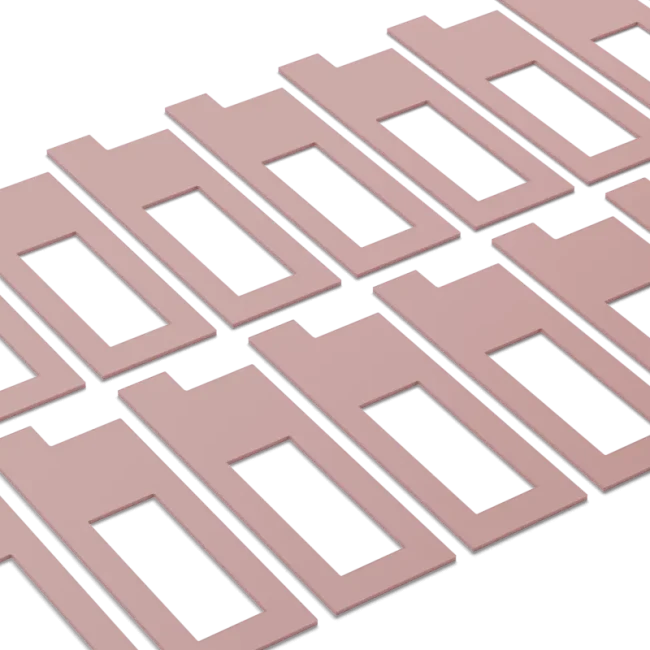
AS02, AS03, AS05, AS06, and AS07 are LiPOLY’s new-generation thermal interface materials, covering both pad and paste/gel types. LiPOLY also offers the DTT54-s, DTT55-s, and DTT56-s two-part thermally conductive die attach adhesives and the DTT61-s thermal pad for immersion cooling. These product types can be selected according to assembly processes and gap requirements. Contact the LiPOLY sales team for specifications, samples, and the complete test report.
FAQ
Q1: What Is the Difference Between Single-Phase and Two-Phase Immersion Cooling?
In single-phase immersion cooling, the coolant remains liquid during operation and is pumped through a heat exchanger for cooling before being recirculated. In two-phase immersion cooling, the coolant boils and vaporizes at the surface of heat-generating components, removes heat through latent heat of vaporization, and then condenses back into liquid. In both systems, the materials inside the server are directly immersed in the coolant.
Q2: What Types of Immersion Cooling Fluids Are Available?
The main types include hydrocarbon-based fluids, ester-based fluids, silicone oils, and fluorinated fluids. Hydrocarbon-based fluids include mineral oil, PAO, and GTL synthetic oil. Hydrocarbon-based fluids are the most common in single-phase systems. Fluorinated fluids are often used in two-phase systems, but they are PFAS substances, and their supply and regulatory environment are changing. Different coolant types exhibit different compatibility with polymer materials, so each material must be verified individually during selection.
Q3: Why Must TIM Compatibility Be Specifically Verified for Immersion Cooling?
Because TIMs remain directly immersed in coolant for extended periods, they may experience swelling, thermal performance degradation, or component leaching. These changes can alter the BLT and thermal resistance, affecting chip temperature and potentially contaminating the coolant.
Q4: How Is Immersion Cooling Compatibility Testing Typically Performed?
A common approach is to fully immerse material specimens in the target coolant and maintain them at a temperature above the actual operating temperature. For example, specimens may be immersed at 80°C for at least 21 days, followed by comparisons of material appearance, coolant appearance, thermal conductivity, and hardness before and after immersion.
Q5: What Does a ±10% Change in Thermal Conductivity Mean?
According to the simplified thermal resistance formula R ≈ BLT ÷ k, if the BLT remains unchanged, a 10% decrease in thermal conductivity results in an approximately 11% increase in the thermal resistance of the layer. Keeping the change within ±10% indicates that the material’s thermal performance remains close to its original design value after long-term immersion.
References
- Arcadis. “Liquid Immersion Cooling for Sustainable Data Centers,” 2024.
- ACHR News. “Immersion Cooling for Data Centers.”
- Inventec Performance Chemicals. “Evaluating Immersion Cooling Fluids for Data Centers: A Comparative Study between Hydrocarbon Oils and Fluorinated Fluids” (White Paper), 2024.
- Schneider Electric. “Comparing Dielectric Fluid Choices to Find the Best Solution for Your Data Center Liquid Cooling Needs,” 2020.
- 3M Company. Form 10-K for the Fiscal Year Ended December 31, 2025. U.S. Securities and Exchange Commission.
- 3M Company. “PFAS Manufacturing Phase Out — Customer Letter,” 2022.
- Materials Research Society. “Degradation Kinetics of Thermal Interface Materials in Single-Phase Liquid Immersion Cooling Systems” (EL10.12.05), 2025 MRS Fall Meeting & Exhibit.
- Lee, J. N., Park, C., Whitesides, G. M. “Solvent Compatibility of Poly(dimethylsiloxane)-Based Microfluidic Devices.” Analytical Chemistry, 75(23), 6544–6554, 2003. DOI: 10.1021/ac0346712.
- International Business Machines Corporation. “Silicone-Based Thermal Interface Materials.” U.S. Patent No. 9,911,681 B2.
- Yu, L., Yang, J., Shia, D., et al. “A Study on Compatibility of Thermal Interface Materials with Coolants for Data Center Immersion Cooling.” 2022 21st IEEE Intersociety Conference on Thermal and Thermomechanical Phenomena in Electronic Systems (iTherm), 2022. DOI: 10.1109/iTherm54085.2022.9899572.
- Submer. “Navigating Material Compatibility in Immersion Cooling.”
- Engineered Fluids. “Material Compatibility Guide — Simplified Material Compatibility Testing Procedure.
- Shell. “Shell Immersion Cooling Fluid S3 X — Technical Data Sheet,” v1.7, 2022.
- Univar Solutions. “Shell Immersion Cooling Fluid S3 X — Product Information.
- Cisco Systems and Shell. “Optimizing AI Compute with Shell Immersion Cooling Fluid” (Partner Alliance Solution Brief).
- Shiu Li Technology Co., Ltd. (LiPOLY). “Shell S3X Immersion Cooling Fluid Compatibility Test Report — AS02, AS03, AS05, AS06, AS07” (internal test report), 2026.
- Shiu Li Technology Co., Ltd. (LiPOLY). “2026 Shiu Li E-Catalogue,” 2026.
Related Products