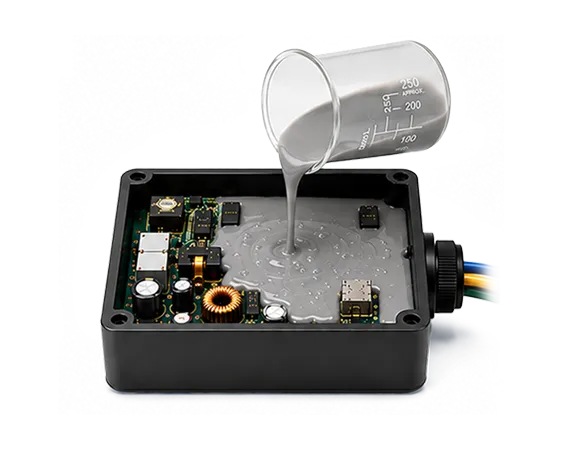
Liquid TIM selection must account for gap size, viscosity, flow behavior, thermal conductivity, thermal resistance, curing method, working time and application process.
Check the Gap and Fill Area
Liquid materials can fill irregular surfaces and complex gaps, but the gap size, depth, tolerances and dispensing location must still be confirmed.
KEY POINT
Minimum and maximum gap
Fill depth and area
Component height differences
Narrow or complex structures
Compressed thickness after dispensing
TIPS
More material is not always safer. Excess material may overflow, contaminate nearby components and increase material costs.
Choose Viscosity and Flow
Viscosity affects dispensing speed, shape retention, application on vertical surfaces and the ability to fill small gaps.
KEY POINT
Dispensing equipment and needle size
Horizontal or vertical application
Required flow and self-leveling
Need to retain the dispensed shape
Production cycle time
TIPS
Low-viscosity materials flow easily but may overflow. High-viscosity materials retain their shape but may require greater dispensing pressure and place more load on the equipment.
Choose One-Part or Two-Part
Products may be one-part putties, two-part gap fillers, bonding adhesives or potting compounds, with substantially different process and equipment requirements.
KEY POINT
Need for mixing equipment
Mixing ratio and accuracy
Curing requirement
Working Time
Production-line automation level
TIPS
An inaccurate ratio or uneven mixing in a two-part material may affect curing, thermal performance and reliability. Finished-product specifications must be considered together with process control.
Evaluate Conductivity and Thermal Resistance
Liquid materials improve surface conformity, but actual thermal performance still depends on thermal resistance, compressed thickness and contact quality.
KEY POINT
Material thermal conductivity
Compressed thickness
Contact area
Long-term change in thermal resistance
TIPS
Completely filling the space does not guarantee low thermal resistance. Excess thickness, trapped air or insufficient compression may still result in poor thermal performance.
Assess Equipment and Process Capability
Liquid materials may require dispensing, mixing, coating, compression or curing equipment. Selection must account for the actual production process.
KEY POINT
Manual or automated dispensing
Dispensing valve and needle specifications
Mixing equipment
Dispensing rate and repeatability
Cleaning and material-change time
Production cycle time
TIPS
Even a high-performance material may cause stringing, interrupted flow, clogging or inconsistent dispensing volumes if it is incompatible with the existing equipment.
Check Curing and Working Time
For materials that require curing, confirm the curing temperature, curing time, working time and post-assembly waiting conditions.
KEY POINT
Room-temperature or heat curing
Curing time
Working Time
Initial setting time
Production-line waiting time
Hardness and shrinkage after curing
TIPS
If the working time is too short, assembly may not be completed in time. If it is too long, it may slow the cycle and create a production bottleneck.
Check Electrical and Structural Functions
In addition to heat transfer, a liquid material may need to provide bonding, potting, cushioning, electrical insulation or sealing.
KEY POINT
electrical insulation
Bonding and adhesion
Cushioning and stress absorption
Moisture protection and sealing
Hardness after curing
Serviceability
TIPS
Bonding adhesives, gap fillers and potting compounds may all be liquid thermal materials, but they serve different functions. They should not be substituted based on thermal conductivity alone.
Assess Environment and Special Requirements
Select the formulation according to temperature, coolant exposure, vacuum conditions, weight limits and material compatibility.
KEY POINT
High temperature and thermal cycling
Coolant compatibility
Non-silicone and low-outgassing requirements
Lightweight Requirements
Compatibility with contact materials
Long-term reliability
TIPS
Non-silicone, low outgassing, lightweight construction and immersion-cooling compatibility are separate properties and must be evaluated individually.
Thermal paste is a thermal interface material with good flow and leveling properties. It fills tiny gaps between a heat sink and a heat-generating component, reducing the thermal resistance caused by trapped air between uneven surfaces and improving heat transfer.
FEATURE
windshield_heat_front
High conductivity
reduces interface thermal resistance and improves heat transfer.
upcoming
Gap Filling
fills microscopic surface irregularities and increases contact area.
flash_off
Electrical Insulation
provides electrical isolation and reduces short-circuit risk.
lock_clock
Long-Term Stability
heat and aging resistance support stable performance.
build
Easy Application
simple to handle and spread across various cooling applications.
STEPS
1
Clean the surfaces
Remove dust, oil and foreign matter.
2
Apply Precisely
Dispense the appropriate amount of thermal paste onto the heat-generating component.
3
Spread Evenly
Completely fill the contact area without trapping air.
4
Position the Assembly
Place and secure the heat sink or housing.
5
Secure and Test
After fastening, test the function and thermal performance.
Thermal gel is a highly soft and conformable thermal interface material designed to fill small gaps between chips, heat sinks and heat-generating components. It reduces contact thermal resistance, supports rework and is suitable for automated dispensing and high-volume production.
FEATURE
windshield_heat_front
Low Thermal Resistance
supports efficient heat transfer.
compress
Soft and Conformable
fills uneven surfaces.
auto_awesome_motion
Automation Ready
suitable for automated dispensing.
autorenew
Reworkable
supports easier removal and maintenance.
lock_clock
Long-Term Stability
resists drying and cracking.
STEPS
1
Clean the surfaces
Remove dust, oil and foreign matter.
2
Dispense Precisely
Apply the material to the heat-generating component.
3
Spread Evenly
Completely fill the contact area without trapping air.
4
Position the Assembly
Place and secure the heat sink or housing.
5
Secure and Test
After fastening, test the function and thermal performance.
Thermally conductive potting compound is a flowable thermal encapsulant designed to surround electronic components and circuit modules. It transfers heat while providing water, dust, moisture, vibration and impact protection for demanding environments and high-reliability electronics.
FEATURE
windshield_heat_front
Heat Transfer and Protection
combines thermal performance with encapsulation.
water_drop
Water and Dust Protection
protects against water, moisture and dust.
domain
Vibration and Impact Resistance
reduces vibration-related damage.
battery_android_frame_full
Longer Service Life
supports extended equipment life.
capture
Complete Filling
suits complex structures and cavities.
STEPS
1
Mix the Material
Combine Parts A and B at the specified ratio and mix thoroughly.
2
Pour and Fill
Dispense the compound into the target area and fully encapsulate the components.
3
Remove Air and Level
Eliminate process bubbles and avoid voids.
4
Cure
Cure at room temperature or with heat according to the product specification.
5
Complete Encapsulation
After curing, the material forms a protective layer for heat transfer and long-term protection.
Thermal gap filler is designed to fill larger gaps between heat-generating components and heat sinks. It transfers heat and accommodates assembly tolerances, making it suitable for electronic modules with significant height differences and high-power equipment.
FEATURE
windshield_heat_front
Stable Heat Transfer
creates a reliable thermal path.
calendar_view_day
High Compressibility
accommodates assembly tolerances.
upcoming
Large-Gap Filling
accommodates height differences.
compress
Lower Compression Damage
reduces stress-related component damage.
auto_awesome_motion
Production Ready
supports automated dispensing.
STEPS
1
Clean the surfaces
Remove dust, oil and foreign matter.
2
Dispense Precisely
Apply the material to the heat-generating component.
3
Fill the Gap
Completely fill the contact area without trapping air.
Thermally conductive die attach adhesive provides high bond strength for precise die attachment to substrates, lead frames and package carriers. It creates an efficient thermal path for rapid chip cooling and is widely used in advanced semiconductor packaging and high-power component manufacturing.
FEATURE
windshield_heat_front
Efficient Heat Transfer
rapidly conducts heat away from the die.
compress
High Bond Strength
securely bonds the die to the substrate.
lock_clock
Package Reliability
improves long-term product stability.
device_thermostat
Thermal-Cycle Resistance
withstands demanding operating conditions.
auto_awesome_motion
Precision Processing
supports semiconductor mass production.
STEPS
1
Clean the Substrate
Remove fine dust and contaminants from the die and substrate.
2
Dispense Precisely
Apply a controlled amount at the specified bonding location.
3
Place the Die
Position and align the die for uniform contact.
4
Cure
Cure at room temperature or with heat according to the standard process.
5
Inspect the Package
Verify bond strength and overall thermal performance.
Reduce Siloxane Outgassing and Contact Contamination
Evaluate material outgassing, condensable substances and water-vapor regain to reduce the risk of contaminating lenses, sensors and precision components in vacuum or sealed environments.
Low Outgassing
For Vacuum and High-Cleanliness Applications
The stable formulation is designed to limit oil migration and volatile emissions, helping reduce contamination of nearby components and improve long-term equipment reliability.
Non-Sag Stability
Maintains Shape and Position
Good shape retention helps prevent flowing or dripping when applied to vertical surfaces, sidewalls and irregular locations, maintaining a stable application area and thickness.
Electrical Insulation
Heat Transfer with Electrical Isolation
High volume resistivity and dielectric breakdown voltage provide electrical isolation between components and metal heat sinks, suiting power devices and high-voltage electronic modules.
Wave Absorption
Manage Heat and Electromagnetic Interference
Sheet-form material combines heat conduction with electromagnetic-wave absorption to help reduce signal interference across frequency bands and address hotspots. It suits millimeter-wave, terahertz, radar and communications equipment.
Gap-Filling Conformability
Fills Height Differences and Complex Gaps
Conforms to height differences and small surface irregularities, fills complex gaps, increases effective contact area and further reduces interface thermal resistance.
Liquid TIM Selection FAQs
What is the difference between a liquid gap filler and a thermal pad?
A
Liquid materials fill irregular surfaces, complex structures and larger tolerances and are suitable for automated dispensing. Thermal pads offer easier control of thickness and shape, cleaner installation, and quick application and replacement.
What is the difference between one-part and two-part materials?
A
One-part products can generally be dispensed directly and use a simpler process. Two-part products require ratio-controlled mixing and may provide curing, bonding or potting functions, but place greater demands on equipment and process control.
Is lower viscosity always better?
A
Not necessarily. Low viscosity supports flow and small-gap filling but may cause overflow. High viscosity retains its shape and is better suited to vertical surfaces or localized dispensing.
How should the dispensing volume be determined?
A
Set the volume according to the contact area, gap, compressed thickness and allowable overflow, then verify it through sample trials. Too little material leaves voids; too much may contaminate nearby components.
Do liquid thermal materials require curing?
A
Not always. Some putties and gap fillers can be used without curing. Bonding adhesives, potting compounds and certain two-part materials may require room-temperature or heat curing.
Thermal Solutions Expert
SHIU LI TECHNOLOGY CO., LTD.
Taoyuan City, Bade District, Yongfeng Road, No. 435
Product News | N700C, N800A-s, N800B, and N800C Non-Silicone Thermal Pads Comply with ASTM E595 Test Requirements. For detailed specifications, please refer to the product datasheets.